






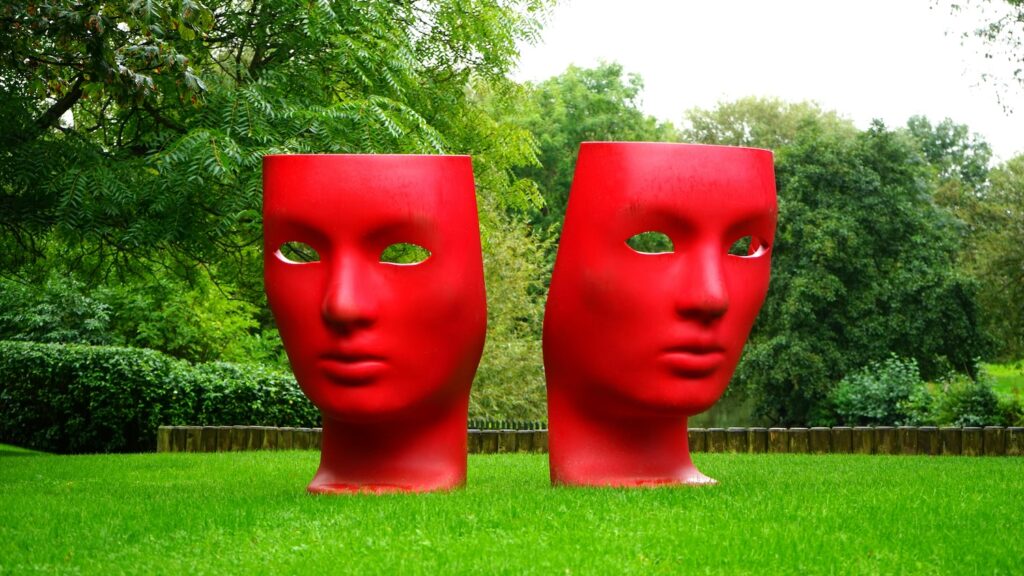
Who Am I Outside the Mask?
By Michelle Labine, PhD
September 2025
My mask was never about being the “easygoing partner.” I wasn’t that. My mask was achievement. I was the one who got things done the lists, the planning, the remembering, the fixing. If something needed to be taken care of, I was already on it. On the surface, it looked like strength and responsibility. People saw me as capable, reliable, the partner who kept everything running.
But here’s the truth: I was exhausted. And underneath all that doing, there was a quieter fear: If I stop, if I rest, will I still be lovable?
When my partner said to me one night, “I want to know the real you,” I froze. I thought I was showing up fully look at everything I manage, look how much I hold. But he wasn’t asking for the mask. He was asking for the part of me that I rarely let anyone see: the one who feels tired, messy, unsure, vulnerable. And that was terrifying.
The Many Faces of the Mask
As a psychotherapist working with couples, I’ve come to see that people wear all sorts of masks in love and conflict. None of them are “wrong.” They all formed for good reasons survival, safety, belonging. Still, when they stay on too long, they keep us from being known.
Here are some of the ways the mask shows up:
- The Achiever (my mask)
The Achiever mask says: “If I keep producing, fixing, and accomplishing, then I’ll stay lovable.” It’s the mask of control, competence, and relentless responsibility.
In relationships, this shows up as doing the laundry before being asked, booking the appointments, staying on top of the finances, holding it all together. It looks like strength. But it leaves little space for vulnerability. The Achiever can’t rest, because rest feels like weakness. And weakness feels dangerous.
- The Performer
The Performer mask is charm, humour, and entertainment. It says: “If I keep you laughing, impressed, or entertained, you won’t leave me.”
In social spaces, this mask is magnetic. Everyone loves being around the Performer. In relationship, though, it can create distance. The real self quiet, raw, messy rarely gets airtime. Underneath the jokes and sparkle is a fear that if they stop dazzling, they’ll be forgotten.
- The Defender
The Defender mask is armour. It says: “If I stay strong and confrontational, no one can hurt me.”
In conflict, the Defender is quick, sharp, maybe even intimidating. They look powerful, but inside they’re protecting tender spots. The mask hides vulnerability with fire. The challenge is that intimacy requires softness and the Defender risks never letting anyone close enough to see their true heart.
- The Chameleon
The Chameleon mask is all about adaptation. It says: “If I shape-shift into what you need, I’ll stay safe.”
In partnership, this shows up as agreeing quickly, avoiding friction, and adjusting preferences so the other person is comfortable. On the outside, it looks like flexibility. On the inside, it feels like invisibility. The Chameleon longs to be loved for who they are but the mask keeps that self hidden.
- The Caretaker
The Caretaker mask is about managing emotions. It says: “If I take care of you, I’ll keep the peace and protect myself.”
In relationships, this looks like soothing quickly, rushing to solve problems, or carrying responsibility for everyone’s wellbeing. The Caretaker seems generous but often runs on empty. The hidden cost is resentment: giving endlessly without receiving, never trusting that their needs are just as valid.
What all of these masks have in common is this: they’re strategies for safety. They helped us belong, stay in relationship, and avoid rejection. But they also keep us from the deeper intimacy we crave because intimacy requires showing up without the shield.
How My Mask Shows Up in Conflict
For me as an Achiever, conflict often became a proving ground. If my partner raised an issue, I would quickly jump into explanation, justification, or fixing. I wanted to resolve it efficiently, to have the right answer, the airtight reasoning, the clear solution. On the surface, it looked like competence. But underneath, it was fear: if I didn’t “win” or “solve,” maybe I would lose love.
The problem was this left no space for vulnerability. What I didn’t say was: “That hurt me. I feel scared. I need you to understand.” Instead, my partner got the polished argument, not the softer truth.
That’s the problem with the mask: it gives the illusion of strength but keeps intimacy out of reach.
The Risk of Being Seen
Relationships are mirrors. They reflect our love and also our survival strategies. When someone says, “I want to know the real you,” it’s an invitation but it can also feel like exposure.
The irony is this: we long for real connection, but when the chance comes, we flinch. Because authenticity means risk. It means: what if they don’t like what they see? What if I’m not enough without the mask?
Slowly, Gently, Re-learning Myself
Here’s what I’ve been practicing slowly, clumsily, imperfectly:
Noticing when I slip into performance. Am I trying to prove, fix, or manage? Or am I speaking from my actual heart?
Sharing small truths. Saying, “I’m too tired for that tonight” or “I actually need quiet right now.” Small things that chip away at the mask.
Letting my partner into the process. Saying, “I’m still figuring out who I am outside the mask. Can you be patient with me?”
Making space where I don’t have to perform. Cozy rituals, shared silence, places where nothing needs to be “done.”
Offering myself compassion. The mask was protection. I can thank it and still choose to take it off sometimes.
Partnership as Healing
I’m learning that partnership can be a place of deep healing, but only if both people are willing to welcome what’s underneath. When the mask comes off and I let myself be messy, quiet, uncertain… and my partner stays, something inside me loosens.
Reflection Prompt:
Which mask do you wear most often in your relationships? And what might it feel like to set it down, even for a moment?